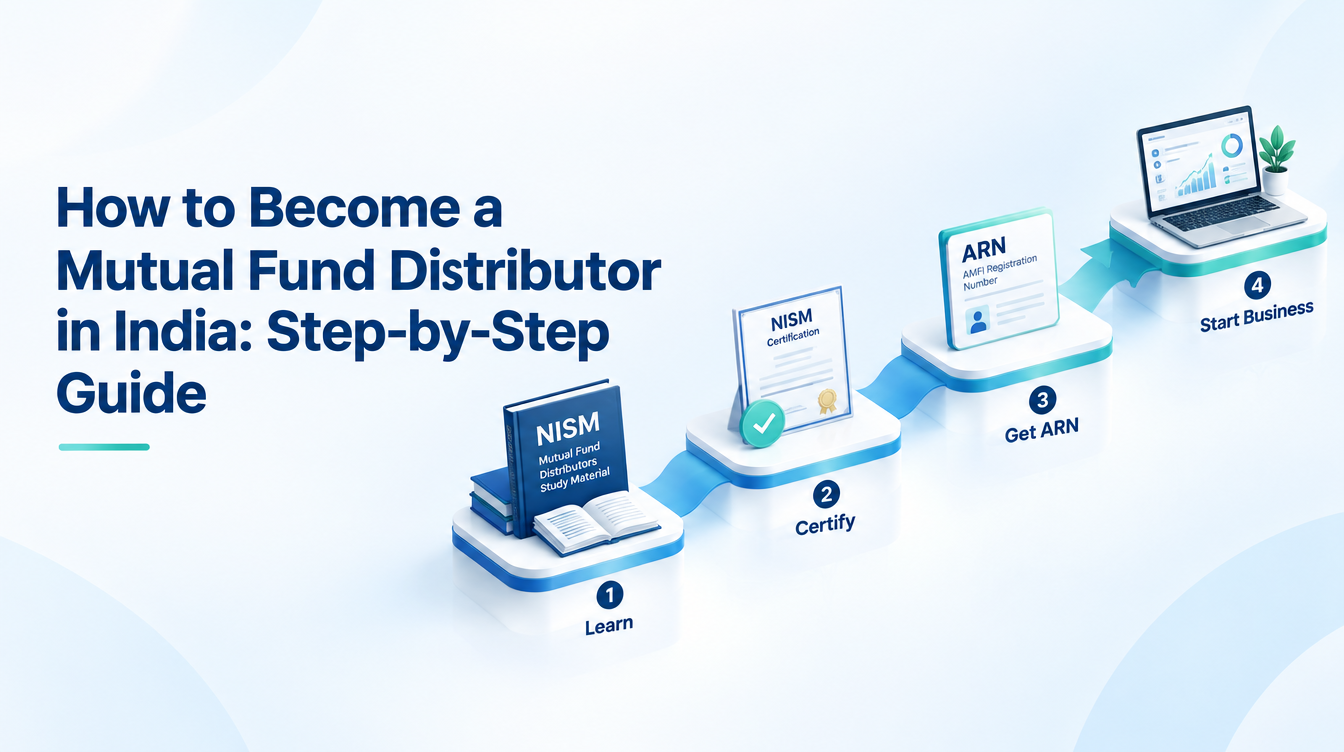
If you are searching for how to become a mutual fund distributor in India, the process is relatively straightforward, but there are several regulatory and business steps you need to complete before you can start distributing mutual fund products.
For an individual, the core route involves clearing the NISM Series VA: Mutual Fund Distributors Certification Examination, obtaining the required NISM certification, registering with the Association of Mutual Funds in India (AMFI), and obtaining an AMFI Registration Number (ARN). You also need to complete the applicable Know Your Distributor (KYD) requirements and get formally empanelled with the Asset Management Companies (AMCs) whose mutual fund schemes you intend to distribute.
However, getting an ARN is not the end of the process.
A successful mutual fund distributor needs to understand mutual fund products, investor suitability, distribution rules, commissions, client servicing, compliance, AMC empanelment and business development.
This guide explains how to become a mutual fund distributor in India step by step, including eligibility, NISM VA, ARN registration, KYD, EUIN, documents, fees, AMC empanelment, income potential, business setup, client acquisition and common mistakes to avoid.
Quick Answer: How to Become a Mutual Fund Distributor in India?
The basic journey is: Check eligibility → Clear NISM Series VA → Obtain NISM certificate → Apply for AMFI ARN → Complete KYD → Receive ARN/EUIN → Get empanelled with AMCs → Set up your distribution business → Start acquiring and servicing investors
For an individual applicant, AMFI currently requires the applicant to be at least 18 years old, hold a valid NISM VA certificate and provide PAN and Aadhaar for the applicable KYD and registration process.
The NISM Series VA examination currently has 100 questions, carries 100 marks, has a two-hour duration, requires 50% to pass and has no negative marking. NISM currently lists the examination fee at ₹1,500.
For an individual, AMFI's current ARN registration fee schedule lists ₹3,000 plus 18% GST, making the registration fee ₹3,540 including GST.
Therefore, the basic NISM examination and individual ARN registration cost is approximately ₹5,040, excluding optional NISM VA training, travel, technology, marketing, and other business expenses.
What Is a Mutual Fund Distributor?
A Mutual Fund Distributor (MFD) is an individual or entity involved in distributing mutual fund products to investors.
A distributor can help investors understand mutual fund products and facilitate transactions and ongoing services within the applicable regulatory framework.
Mutual fund distributors may operate independently or through a financial services organisation, bank, brokerage, distribution platform or other eligible business structure.
The role involves much more than simply selling mutual fund schemes.
A professional MFD may be involved in:
- Explaining mutual fund concepts to investors
- Helping investors understand available schemes
- Facilitating mutual fund transactions
- Supporting SIP and other investment transactions
- Providing investor service
- Maintaining client relationships
- Assisting with documentation and operational requirements
- Keeping up with applicable regulations
- Building a long-term distribution business
The profession can be pursued as a full-time or part-time career, subject to the applicable requirements. AMFI itself describes independent mutual fund distribution as a potential full-time or part-time profession.
Who Can Become a Mutual Fund Distributor in India?
One of the advantages of the MFD profession is that an individual does not need to have an MBA or finance degree as a prerequisite for ARN registration.
For an individual applicant, AMFI currently specifies that the applicant should:
- Be at least 18 years old
- Hold a valid NISM VA certification
- Have PAN
- Have Aadhaar or meet the applicable KYC requirements
- Complete the required KYD and AMFI registration process
AMFI also has provisions for non-individual entities. A non-individual applicant must have at least one employee or sales personnel who has passed the applicable NISM examination and meets the relevant EUIN requirements.
Potential MFDs can include:
- Graduates
- Banking professionals
- Insurance professionals
- Financial services professionals
- Entrepreneurs
- Self-employed individuals
- Retired professionals
- People looking for a second income stream
- Individuals interested in building a financial distribution business
Eligibility is only the first step. A successful MFD also needs financial knowledge, communication skills, relationship-management ability, and a strong understanding of compliance.
Do You Need a Finance Degree or MBA to Become a Mutual Fund Distributor?
No, a finance degree or MBA is not a mandatory requirement for an individual to become a mutual fund distributor.
The important regulatory requirements include the applicable NISM certification and AMFI registration/ARN requirements. AMFI's registration criteria for individuals focus on age, NISM certification, PAN, Aadhaar/KYD and registration requirements rather than a finance degree.
However, a background in finance, banking, insurance, sales, or financial services can be useful.
If you do not have a finance background, you can build your knowledge through:
- NISM VA study material
- Structured preparation
- Practical learning
- Mutual fund industry resources
- Continuous professional education
- Experience interacting with investors
Mutual Fund Distributor Registration Process in India
The process can be understood in the following stages:
Step 1: Check your eligibility
Make sure you meet the applicable requirements.
Step 2: Prepare for NISM Series VA
Study mutual fund concepts, distribution, suitability, taxation, regulation, and related topics.
Step 3: Clear NISM Series VA
Pass the certification examination and obtain your NISM certificate.
Step 4: Apply for AMFI registration
Submit your ARN application through the prescribed online process.
Step 5: Complete KYD
Complete the applicable Know Your Distributor requirements using PAN, Aadhaar and/or valid KYC status as prescribed.
Step 6: Receive your ARN/EUIN
Once the application, documentation, and payment are processed, AMFI/CAMS allots the applicable registration number. Individual MFDs are allotted an EUIN along with an ARN by default.
Step 7: Complete AMC empanelment
Apply for empanelment with the AMCs whose mutual fund products you intend to distribute.
Step 8: Set up your business
Choose your operating model, technology, transaction infrastructure, client-servicing process, and marketing strategy.
Step 9: Start acquiring and servicing investors
Build your investor base through education, referrals, networking, digital content, and long-term client relationships.
Step 1: Understand Mutual Funds and the MFD Business
Before taking the NISM examination, understand what the profession involves.
You should develop a working knowledge of:
- Equity mutual funds
- Debt mutual funds
- Hybrid funds
- Index funds
- Tax-saving mutual funds
- SIPs
- STPs
- SWPs
- NAV
- Expense ratio
- Exit load
- Risk and return
- Asset allocation
- Investor suitability
- KYC requirements
- Mutual fund taxation
- Mutual fund regulations
- Investor services
NISM's curriculum is designed to provide candidates with knowledge of mutual fund concepts, scheme types, distribution, scheme evaluation, suitability, legal and regulatory aspects, taxation and financial planning.
You do not need to become an expert before taking the first step, but you should be prepared to keep learning throughout your career.
Step 2: Clear the NISM Series VA Examination
The NISM Series VA: Mutual Fund Distributors Certification Examination is one of the main requirements for becoming a mutual fund distributor.
AMFI states that a person seeking to become an MFD generally needs to pass the NISM Series VA examination and then register with AMFI to obtain an ARN.
NISM VA Exam Pattern
| Particular | Details |
| Examination | NISM Series VA: Mutual Fund Distributors |
| Questions | 100 |
| Total Marks | 100 |
| Duration | 2 hours |
| Passing Score | 50% |
| Negative Marking | No |
| Examination Fee | ₹1,500 |
NISM's current FAQ confirms the ₹1,500 examination fee, 100 questions, two-hour duration, 50% passing score, and absence of negative marking.
What Does NISM VA Course Cover?
The NISM VA Course covers areas such as:
- Mutual fund basics
- Mutual fund structure
- Types of mutual fund schemes
- Scheme features
- Risk and return
- Mutual fund distribution
- Scheme evaluation
- Investor suitability
- Legal and regulatory requirements
- Accounting and valuation
- Taxation
- Financial planning
- Investor relationships
- Ethical and professional practices
NISM describes the examination as a knowledge benchmark for people involved in mutual fund sales and distribution.
How to Prepare for NISM VA?
A practical preparation strategy is:
- Download or access the official NISM study material.
- Understand the concepts rather than relying only on memorisation.
- Create short notes for important terms and regulations.
- Practice questions regularly.
- Revise taxation, risk, suitability and distribution concepts.
- Take mock tests before the examination.
- Focus on understanding why an answer is correct.
ZLearn can support this stage with structured NISM VA learning resources and preparation material.
Step 3: Obtain Your NISM Certificate
Passing the examination is an important milestone, but it does not by itself make you a registered mutual fund distributor.
After passing NISM VA, you need to proceed with the applicable AMFI registration and ARN process.
AMFI states that the MFD or employee of the MFD must pass the NISM Series VA examination and obtain the NISM certificate before applying for AMFI registration to obtain ARN/EUIN, subject to applicable exemptions.
Step 4: Apply for AMFI Registration and Obtain ARN
ARN stands for AMFI Registration Number.
It is the registration identity associated with a mutual fund distributor or eligible distribution entity.
AMFI has engaged CAMS to carry out end-to-end activities related to ARN/EUIN registration and renewal. The current application process is online.
The broad process is:
- Pass NISM Series VA.
- Obtain your NISM certificate.
- Keep PAN and Aadhaar/KYC information ready.
- Visit the AMFI distributor registration section.
- Select the online registration option.
- Submit the required information.
- Complete the applicable KYD process.
- Pay the applicable registration fee.
- Receive your ARN/EUIN after successful processing.
AMFI's current process requires an online application and uses Aadhaar/PAN authentication or applicable validated KYC for KYD.
Step 5: Complete KYD — Know Your Distributor
KYD means Know Your Distributor.
KYD is the distributor-side verification process that must be completed as part of initial AMFI registration.
For individual applicants, AMFI's current process requires Aadhaar and PAN or an applicable validated KYC status for KYD.
The process has changed from the older physical biometric approach.
AMFI discontinued the physical biometric process at CAMS Points of Service for fresh ARN registration and made online registration mandatory from October 1, 2024.
This means a new applicant should follow the current online AMFI process, rather than relying on older articles that instruct applicants to complete physical biometrics at a CAMS centre.
Step 6: Understand ARN and EUIN
Two important terms you will encounter are ARN and EUIN.
What Is ARN?
ARN stands for AMFI Registration Number.
It identifies the mutual fund distributor or distribution entity registered with AMFI.
What Is EUIN?
EUIN stands for Employee Unique Identification Number.
It identifies the employee, relationship manager, or salesperson interacting with investors for the sale or distribution of mutual fund products.
AMFI states that an individual MFD is allotted an EUIN along with an ARN by default, without a separate application or additional charge. For non-individual distributors, applicable employees involved in distribution need to meet the relevant certification and EUIN requirements.
EUIN is important because it helps identify the person who sourced a transaction and can assist in tracing cases involving mis-selling or service deficiencies.
Step 7: Complete AMC Empanelment
This is one of the most important points that new MFDs often miss.
Is ARN Enough to Start Selling Mutual Funds?
No, obtaining an ARN does not automatically give an MFD the right to distribute every mutual fund scheme in the market.
AMFI states that an MFD must be formally empanelled with the concerned AMC before conducting mutual fund business for that AMC. Transactions received under the ARN of a non-empanelled MFD can be processed under the Direct Plan.
Therefore, the practical journey is:
NISM VA → AMFI Registration → ARN → AMC Empanelment → Distribution
This is an important distinction for anyone planning to start an MFD business.
Step 8: Decide Whether to Operate as an Individual or Entity
A mutual fund distribution business can be structured as an individual or through an eligible non-individual entity.
For someone starting independently, an individual MFD structure may be the simplest route.
As the business grows, other structures may be considered, depending on business requirements and professional advice.
Non-individual applicants have additional requirements.
AMFI states that a non-individual entity applying for ARN should have at least one employee or sales personnel who has passed the required NISM examination and obtained the applicable EUIN. Additional documents and KYD requirements may apply depending on the entity type.
Potential entity structures can include eligible:
- Proprietorships
- Partnership firms
- LLPs
- Companies
- Trusts
- Societies
- Other permitted entities
The exact documentation and registration fee depend on the applicant category.
Documents Required to Become a Mutual Fund Distributor
The exact documents can vary according to whether you apply as an individual or non-individual entity.
For an Individual MFD
Generally, you should keep the following ready:
- PAN
- Aadhaar
- Valid NISM Series VA certificate
- Required KYC information
- Bank details/documents as applicable
- Contact details
- Other information requested during ARN registration
AMFI specifically identifies PAN and Aadhaar as mandatory for online individual ARN/EUIN registration, subject to the applicable KYD process.
For Non-Individual MFDs
Additional documents may be required depending on the entity structure.
These may include:
- Entity PAN
- Incorporation/registration documents
- Partnership deed, where applicable
- LLP/company documents
- Board or partner resolutions
- Authorised signatory details
- PAN and Aadhaar/KYC details of designated officials
- NISM certification and EUIN number details of relevant personnel
- Bank-related documents
- Other documents prescribed for the applicant1,500 NISM fee and ₹3,540 ARN registration fee, including GST. Additional expenses depend on training, technology, marketing, business setup, and other requirements.
Before submitting an application, check the latest AMFI documentation for your specific applicant category.
How Much Does It Cost to Become a Mutual Fund Distributor?
The initial regulatory cost is relatively accessible for an individual, although the total cost of starting a distribution business will depend on your operating model.
Estimated Core Cost
| Expense | Approx. Cost |
| NISM Series VA Examination | ₹1,500 |
| Individual ARN Registration | ₹3,000 |
| GST on ARN Registration @ 18% | ₹540 |
| ARN Registration Including GST | ₹3,540 |
| Basic NISM + ARN Cost | ₹5,040 |
| Training/study resources | Free with ZFunds |
| Business setup | Free with ZFunds |
| Technology/platform | Free with ZFunds |
| Marketing | Free with ZFunds |
NISM currently lists the Series VA examination fee at ₹1,500.
AMFI's published fee schedule lists ₹3,000 as the individual ARN registration fee, plus 18% GST.
Therefore: ₹1,500 + ₹3,540 = ₹5,040
This ₹5,040 figure represents the basic NISM examination plus individual ARN registration cost. It does not include optional training, study material beyond what is provided through the examination process, travel, professional advice, technology, marketing, office expenses, or other business costs.
Always verify the latest fees before making payment because regulatory fees can change.
Do Mutual Fund Distributors Need GST Registration?
GST requirements depend on the applicable tax rules, turnover, nature of services, and other circumstances.
A new MFD should not assume that GST registration is automatically required from the first day of business.
If your circumstances trigger a GST registration requirement, you should complete the applicable registration and compliance process.
Because GST treatment can depend on individual business circumstances, an MFD should consult a qualified tax professional for specific advice.
AMFI also provides GST-related resources for mutual fund distributors in its distributor resources section.
How Does a Mutual Fund Distributor Earn Money?
Mutual fund distributors can earn distributor commissions from eligible mutual fund distribution business under the applicable regulatory and scheme-level framework.
Income is not a fixed salary for an independent MFD.
The potential income of a distributor can depend on factors such as:
- Number of investors
- Assets under distribution
- Type of mutual fund business
- SIP business
- New investments
- Client retention
- Asset growth
- Applicable Mutual fund commission structure
- Quality of investor service
- Business scale
For this reason, it is better to think of MFD income as a long-term distribution business, rather than a guaranteed monthly income opportunity.
A new MFD may initially earn relatively little while building a client base. As the investor base and assets serviced grow, the economics of the business can change.
Do not promise investors guaranteed returns or represent market-linked investments as risk-free.
How to Start a Mutual Fund Distribution Business
Getting your ARN is only the regulatory beginning. To build a sustainable MFD business, you need an operating model.
Your setup may include:
- Client onboarding process
- Transaction infrastructure
- Investor records
- Portfolio servicing
- SIP tracking
- Communication systems
- Customer support
- Marketing
- Compliance processes
- AMC relationships
- Business accounting
- Technology/platform
You can build the business independently or use an eligible distribution platform that provides technology and operational support.
The right model depends on your goals, resources, target clients, and preferred way of working.
Direct AMC Empanelment vs Distribution Platform
Once you have the required registration, you can evaluate how you want to operate.
Direct AMC Empanelment
You can seek empanelment with individual AMCs and follow their distributor onboarding requirements.
This can give you a direct relationship with the relevant AMC, but you may need to manage multiple processes and systems.
Distribution Platform
Some MFDs use distribution platforms that provide technology, transaction infrastructure, reporting, marketing resources and operational support.
This can make it easier for a new distributor to manage the business, depending on the platform.
Independent Brand With Technology Support
Another approach is to build your own MFD brand while using third-party technology or distribution infrastructure for operational requirements.
Before choosing a platform, compare:
- Technology
- Transaction capabilities
- AMC access
- Reporting
- Customer service
- Back-office support
- Marketing support
- Training
- Charges
- Ease of use
- Business scalability
Do not select a platform solely because it promises higher income.
How to Get Your First Mutual Fund Clients
For a new MFD, obtaining the first few clients can be more challenging than clearing the NISM examination.
Instead of starting with aggressive sales pitches, focus on investor education.
Potential sources of clients can include:
- Existing professional networks
- Friends and family, where appropriate
- Local business owners
- Professional communities
- Referrals
- Educational seminars
- Financial awareness sessions
- Digital content
- Social media
- Existing relationships where permitted
You can create educational content around topics such as:
- What is a SIP?
- How do mutual funds work?
- SIP vs lump-sum investing
- Equity vs debt mutual funds
- How to start investing
- Understanding investment risk
- Common mutual fund mistakes
- Mutual fund taxation
- Long-term investing
- Asset allocation
The objective should be to establish credibility and educate investors rather than simply pushing products.
What Skills Does a Successful Mutual Fund Distributor Need?
Passing NISM VA is necessary for the applicable MFD route, but certification alone does not guarantee business success.
Financial Knowledge
You need to understand the mutual fund products you distribute and their risks, features and costs.
Communication Skills
You should be able to explain financial concepts in simple language.
Relationship Management
Mutual fund distribution is generally a long-term relationship business. Consistent service can help build client trust and retention.
Sales and Marketing
You need to understand lead generation, referrals, meetings, networking, and communication.
Digital Skills
Digital onboarding, online communication, content marketing and social media can help an MFD reach investors efficiently.
Compliance Awareness
You need to understand the applicable regulatory requirements and follow the prescribed code of conduct and processes.
Mutual Fund Distributor vs Investment Adviser
MFDs and investment advisers are often confused, but they operate under different regulatory frameworks and business models.
| Mutual Fund Distributor | Investment Adviser |
| Distribution-focused role | Investment-advice-focused role |
| Requires applicable certification and AMFI registration/ARN | Operates under the applicable SEBI investment adviser framework |
| Earns distributor compensation under the applicable framework | Generally follows a fee-based advisory model |
| Primarily involved in distribution of mutual fund products | Provides investment advice under the applicable regulatory framework |
| Follows MFD requirements and code of conduct | Follows the requirements applicable to registered investment advisers |
The important point is that MFD and RIA are not simply two names for the same profession.
If your objective is to distribute mutual fund products, understand the MFD route.
If your objective is to provide regulated investment advice, study the applicable SEBI investment adviser requirements before choosing your career path.
Can You Become a Mutual Fund Distributor Part-Time?
Yes, mutual fund distribution can be pursued as a part-time profession, subject to applicable regulatory, contractual and employment requirements.
AMFI itself describes an independent MFD as a career that can be pursued on a full-time or part-time basis.
However, part-time does not mean casual.
You still need to:
- Maintain your applicable certification
- Maintain ARN requirements
- Follow applicable regulations
- Provide proper investor service
- Maintain records
- Keep your knowledge updated
- Follow the prescribed code of conduct
- Manage investor relationships responsibly
If you are already employed, you should also check your employment agreement and applicable policies before starting a separate financial distribution business.
Can a Student Become a Mutual Fund Distributor?
Students can prepare for and take the NISM Series VA examination, subject to NISM's applicable examination requirements.
However, an individual applicant for ARN must meet AMFI's applicable registration requirements, including the minimum age of 18 years.
For students interested in financial services, preparing for NISM certification can be a useful way to develop foundational knowledge about mutual funds and the financial services industry.
How Long Does It Take to Become a Mutual Fund Distributor?
There is no single fixed timeline because the process depends on your preparation, examination schedule and registration processing.
A practical journey could look like this:
| Stage | Typical Activity |
| Preparation | Learn mutual fund concepts and prepare for NISM VA |
| Examination | Register for and clear NISM Series VA |
| Certification | Obtain NISM certificate |
| Registration | Apply for AMFI ARN |
| KYD | Complete applicable online KYD requirements |
| ARN | Receive ARN/EUIN after successful processing |
| Empanelment | Complete AMC empanelment |
| Business setup | Set up technology, processes and client servicing |
| Growth | Acquire investors and build your distribution business |
The actual timeline can vary. Always check the latest NISM and AMFI processes before planning your start date.
What Happens After You Get Your ARN?
Getting an ARN is not the final step. It is the point at which you can move into the operational and business-building phase, subject to the required AMC empanelment and other applicable requirements.
A useful roadmap is: Get certified → Get ARN → Complete AMC empanelment → Set up infrastructure → Define target audience → Acquire first clients → Service investors → Build SIP/AUM relationships → Generate referrals → Scale the business
As the number of clients grows, systems become increasingly important. Consider maintaining structured processes for:
- Client onboarding
- Documentation
- Transaction tracking
- SIP monitoring
- Investor communication
- Portfolio servicing
- Compliance reminders
- Referral management
- AMC-related processes
Common Mistakes New Mutual Fund Distributors Should Avoid
Mistake 1: Thinking NISM VA Is Enough
Passing NISM VA is a major milestone, but you still need to complete the applicable AMFI registration and ARN process.
Mistake 2: Thinking ARN Automatically Allows You to Sell Every Mutual Fund
It does not.
AMFI states that an MFD must be formally empanelled with the concerned AMC before conducting business for that AMC.
Mistake 3: Promising Guaranteed Returns
Mutual fund investments are subject to market risks.
Never present market-linked investments as guaranteed or risk-free.
Mistake 4: Focusing Only on Sales
A sustainable distribution business depends on investor education, service, communication and long-term relationships.
Mistake 5: Ignoring Compliance
Keep track of applicable certification, ARN, EUIN, AMC empanelment and other regulatory requirements.
AMFI provides ongoing circulars, code-of-conduct resources and distributor updates that MFDs should monitor.
Mistake 6: Recommending Products Without Understanding the Investor
Before discussing investment options, understand the investor's objectives, risk profile, investment horizon and relevant circumstances within the scope of your role.
Mistake 7: Expecting Immediate Income
Building an MFD business takes time.
The initial focus should be on: Knowledge → Trust → Clients → Service → Retention → Asset growth
Is Becoming a Mutual Fund Distributor a Good Career Option?
Mutual fund distribution can be an attractive career option for people interested in finance, sales, communication and relationship management.
Potential advantages include:
- Relatively accessible entry requirements
- Ability to build your own client base
- Potential for recurring distribution income
- Opportunity to work independently
- Full-time or part-time possibilities
- Scope to build a long-term financial services business
- Growing need for investor education and financial awareness
However, it is not a guaranteed-income profession.
You should consider becoming an MFD if you:
- Enjoy interacting with people
- Are comfortable with sales and relationship management
- Are interested in financial markets
- Can explain financial concepts clearly
- Are willing to keep learning
- Want to build a client-based business
- Understand that business growth takes time
- Are prepared to follow regulatory requirements
What Is the Difference Between ARN and NISM Certification?
This is one of the most common questions asked by new MFDs.
NISM certification and ARN are not the same thing.
NISM Certification
NISM Series VA demonstrates that you have passed the required certification examination for the applicable mutual fund distribution role.
ARN
ARN is the AMFI Registration Number associated with the eligible distributor or entity.
In simple terms:
NISM VA = Certification
ARN = AMFI Registration
Both have different purposes in the MFD registration journey.
How to Become a Mutual Fund Distributor Without Experience?
Prior experience in the financial sector is not generally required to sit for the NISM Series VA examination.
A beginner can start by:
- Learning mutual fund fundamentals.
- Studying the NISM VA curriculum.
- Passing the NISM VA examination.
- Completing AMFI registration.
- Obtaining ARN.
- Completing AMC empanelment.
- Learning investor servicing and business development.
- Building a client base gradually.
Your lack of experience should not be treated as a reason to skip financial education.
In fact, beginners should spend more time understanding mutual funds, suitability, risk and compliance before approaching investors.
Frequently Asked Questions
1. How to become a mutual fund distributor in India?
To become a mutual fund distributor in India, an individual generally needs to clear the NISM Series VA: Mutual Fund Distributors Certification Examination and register with AMFI to obtain an ARN. The applicant also needs to complete the applicable KYD and registration requirements and then complete AMC empanelment before conducting business for the relevant AMC.
2. Is NISM VA mandatory for mutual fund distributors?
For the standard MFD route, AMFI states that a person seeking to become a mutual fund distributor needs to pass NISM Series VA and register with AMFI to obtain ARN, subject to applicable exemptions.
3. What is ARN in mutual funds?
ARN stands for AMFI Registration Number. It is the registration identity associated with an eligible mutual fund distributor or distribution entity.
4. What is the NISM VA exam fee?
NISM currently lists the Series VA examination fee at ₹1,500.
5. What is the ARN registration fee?
AMFI's published fee schedule lists the individual ARN registration fee at ₹3,000 plus 18% GST, making it ₹3,540 including GST.
6. How much does it cost to become a mutual fund distributor?
The basic NISM examination and individual ARN registration cost is approximately ₹5,040, based on the current ₹1,500 NISM fee and ₹3,540 ARN registration fee including GST. Additional expenses depend on training, technology, marketing, business setup and other requirements.
7. Do I need an MBA or finance degree to become an MFD?
No. A finance degree or MBA is not listed by AMFI as a mandatory requirement for an individual ARN applicant. The applicable NISM certification and AMFI registration requirements are the key requirements.
8. Can I become a mutual fund distributor without experience?
Yes. Previous financial-sector experience is not generally required to take the NISM VA examination. However, you need to develop sufficient knowledge of mutual funds and applicable regulations before starting distribution activities.
9. Can I become an MFD part-time?
Yes, subject to applicable requirements. AMFI describes independent MFD as a potential full-time or part-time career.
10. What documents are required for ARN registration?
For an individual applying online, PAN and Aadhaar are required for the applicable registration and KYD process. Additional documents can apply depending on the applicant category.
11. Is ARN the same as NISM certification?
No, NISM certification is the qualification/certification obtained after passing the applicable examination.
ARN is the registration number issued through the AMFI registration process.
12. What is EUIN?
EUIN stands for Employee Unique Identification Number. It identifies the employee, relationship manager or salesperson interacting with investors for mutual fund distribution. Individual MFDs are allotted EUIN along with ARN by default.
13. Can I sell mutual funds immediately after getting ARN?
Not necessarily, AMFI states that an MFD must be formally empanelled with the relevant AMC before conducting business for that AMC. ARN alone does not automatically authorise an MFD to sell every AMC's mutual fund schemes.
14. How does a mutual fund distributor earn?
MFDs can receive distributor commissions from eligible mutual fund distribution business under the applicable regulatory and scheme-level framework. Income depends on factors such as assets serviced, business volume, client retention, scheme-level compensation and the applicable framework.
15. Is mutual fund distribution a good business?
It can be a suitable long-term business for individuals who are interested in finance, sales, investor education and relationship management. However, income is not guaranteed and building a substantial client base can take time.
16. Can a student become a mutual fund distributor?
A student can prepare for and take the NISM VA examination subject to applicable requirements. However, an individual applying for ARN must meet AMFI's applicable eligibility criteria, including the minimum age requirement of 18 years.
17. What is KYD in mutual fund distribution?
KYD means Know Your Distributor. It is the distributor verification process required as part of initial AMFI registration. The current process uses the prescribed PAN/Aadhaar or validated KYC requirements.
18. Can an MFD distribute products from multiple AMCs?
An MFD can distribute mutual fund products of AMCs with which the distributor has completed the applicable empanelment requirements. ARN alone does not automatically provide empowerment with every AMC.
Final Checklist: How to Become a Mutual Fund Distributor
Before starting your MFD journey, use this checklist:
- Understand mutual fund basics
- Check your eligibility
- Prepare for NISM Series VA
- Register for the NISM examination
- Clear NISM VA
- Obtain your NISM certificate
- Keep PAN and Aadhaar/KYC information ready
- Apply for AMFI registration
- Complete KYD
- Obtain your ARN
- Understand your EUIN requirements
- Complete AMC empanelment
- Set up your distribution infrastructure
- Understand applicable compliance requirements
- Develop a client acquisition strategy
- Start educating and servicing investors
- Maintain your certification and registration requirements
- Keep track of AMFI/NISM regulatory updates
Start Your Mutual Fund Distributor Journey with ZLearn
Becoming a mutual fund distributor is more than clearing an examination and obtaining an ARN.
The complete journey involves understanding mutual funds, clearing NISM Series VA, completing AMFI registration and KYD, obtaining ARN, completing AMC empanelment and building the knowledge and skills required to serve investors professionally.
The NISM Series VA examination is one of the first major milestones in this journey.
ZLearn provides learning resources to help aspiring mutual fund distributors understand the NISM VA syllabus, learn mutual fund concepts and prepare for the certification journey.
If you are planning to build a career or business in mutual fund distribution, start with the fundamentals:
Learn the concepts → Clear NISM VA → Get your ARN → Complete AMC empanelment → Build investor relationships → Grow your MFD business.
Learn with ZLearn. Prepare for NISM VA. Build your mutual fund distribution career.